Leadership development that creates visible impact: A leadership development program for emerging leaders and young managers
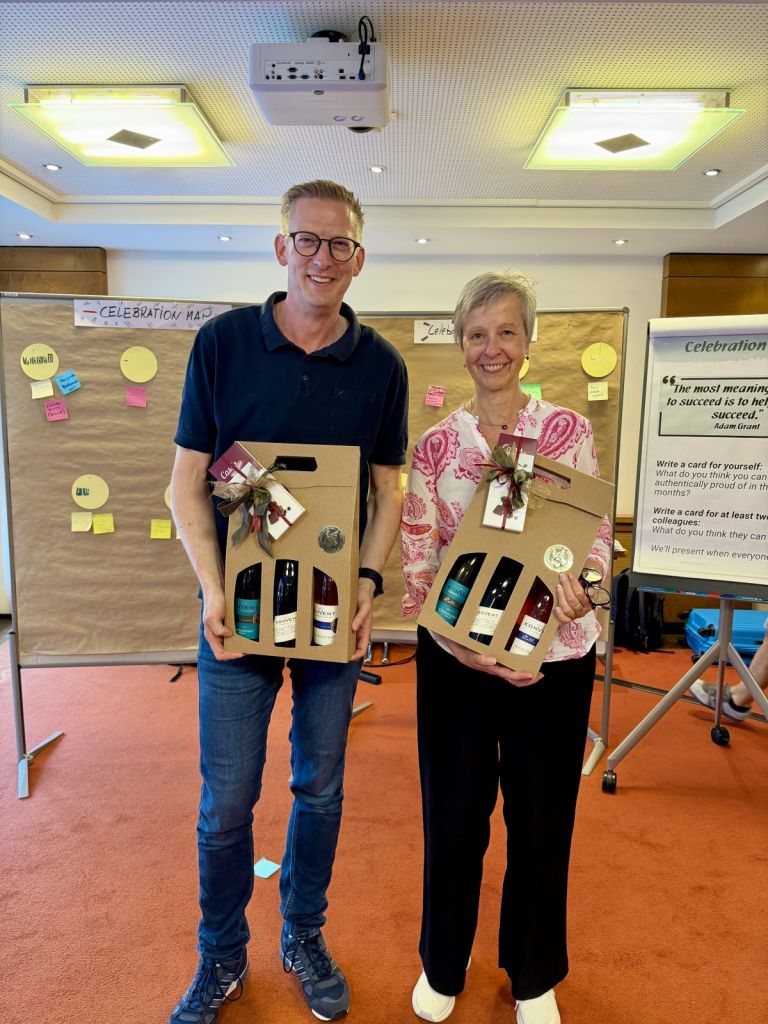
Actually, I wanted to present an effective method from our leadership development program at this point. But then the participants surprised us at the conclusion of our joint leadership development program with personal words and a gift.
This special appreciation touched us deeply – and at the same time showed what sustainable leadership development can achieve.
Over the past ten months, a colleague and I have accompanied 14 executives in a comprehensive development program. During the final training module, we were able to experience firsthand how much the participants had developed both professionally and personally.
More self-confidence, greater clarity in one's own leadership role, more mindful interaction with employees, and a significantly expanded repertoire for demanding leadership situations: The development was not only perceptible, but we were also able to experience it in the behavior of the participants.
Leadership does not develop in a single seminar
A two-day executive training can provide important impulses. However, sustainable behavioral change requires time, reflection, practical experience, and continuous guidance.
That is why, in more comprehensive personnel development projects, we rely on modular leadership development programs. Participants not only learn new methods, but also apply them in their daily work between the modules. Experiences and challenges are then reflected upon together.
This is how a continuous learning process is created:
Learn – try out – reflect – adapt – apply again.
The program described here ran for ten months. Depending on the objectives, target group, and corporate situation, comparable leadership programs can be designed to span a period of approximately ten to twelve months.
Three developmental stages for effective leadership
The executive development program combines personal development, leadership, and entrepreneurial thinking. The training content builds systematically on one another and is divided into three core development stages.
| Development phase | Focus | |
|---|---|---|
| Leading myself | Understand and lead oneself | |
| Lead employees | Inspire and develop employees | |
| managing with numbers & KPIs | Take responsibility for results and collaboration |
Module 1: Effectively Leading Myself
Good leadership starts with oneself. Leaders must know their values, motives, strengths, behavioral patterns, and personal stress reactions before they can effectively lead others.
The first phase of the development program kicks off with a two-day in-person training session. Here, we create a common foundation for future collaboration and enable participants to intensively explore their future or already assumed leadership role.
Reflecting on one's own leadership behavior:
The participants will address the following questions, among others:
- What experiences and beliefs shape my leadership behavior?
- What strengths do I bring to my role?
- How do I come across to different employees?
- What are my personal areas for development?
- What expectations are placed on me as a leader?
A strengths-oriented stocktaking or a value and motivation analysis, e.g. with Profile Dynamics®, can additionally support self-reflection.
Further potential content in the 1st module or in accompanying online modules can include:
Ensure performance and stability (self-management, priority setting, dealing with pressure)
Actively shaping one's own development (definition of personal development goals, reflection on past career, definition of next growth steps)
The goal of the first module is not to copy a specific leadership style. Every manager should develop an authentic yet situation-appropriate leadership style and consciously engage with their own person, their own strengths, and also the demands that arise from leadership activities.
Module 2: Leading others – inspiring employees, empowering them, and building trust
Following the personal self-assessment, the focus shifts to employee leadership. Another joint on-site module opens this second phase of development.
Here, participants learn how to provide guidance, manage professional relationships, and lead employees according to their abilities and needs.
Possible contents of the second module:
Providing guidance and motivation (delegation, explaining context, (goal) communication, communicating clearly and motivatingly, conducting discussions with employees, transferring responsibility).
Developing employees, conducting performance reviews, and delegating responsibility
Therefore, training focuses on, for example:
- situational delegation,
- clear, development-oriented feedback,
- Coaching as a leadership tool,
- clear goal agreements,
- handling of errors,
- the promotion of independence
- conducting discussions with employees (e.g. constructive feedback meetings, goal-setting interviews, annual performance reviews, etc.).
What other content belongs in executive training?
Strengthen trust and psychological safety
High-performing teams require trust. Employees must be able to ask questions, express differing opinions, and also address uncertainties.
Therefore, managers reflect on how trust is built, what damages it, and how they can promote psychological safety through their own behavior.
This is not about harmony at all costs. Trust also builds when leaders address difficult topics early on, explain decisions in a comprehensible way, and act consistently.
Module 3: Managing with Numbers and KPIs, Thinking Like an Entrepreneur, Defining Goals, and Achieving Results Together
In the third phase of development, participants broaden their perspective beyond immediate employee leadership.
Leaders bear responsibility for results, change processes, interfaces, and cooperation within the company. Precisely these requirements are the focus of the 3rd module.
Leading through complexity and change (dealing with change, uncertainty, and conflicting demands)
Enabling performance and driving results (creating clarity on goals, agreements, and feedback)
Shape cross-border collaboration (collaboration with other departments, locations, and hierarchical levels)
Today, many results are no longer generated within a single team. Leaders must collaborate with other departments, locations, hierarchical levels, and diverse stakeholder groups.
Therefore, the training also focuses on cooperation, interface management, conflict resolution, and the establishment of sustainable working relationships.
The program concludes with a joint 2-day on-site module. Here, the most important insights are brought together, personal progress is made visible, acknowledged, and celebrated, and concrete steps for further transfer are agreed upon.
Blended Learning: Learning in training and everyday work
The program combines different learning formats into a seamless learning journey:
- two-day, instructor-led on-site modules,
- virtual live trainings,
- Exchange within peer groups,
- Reflection and transfer tasks,
- Exchange also with experienced managers,
- peer exchange between participants,
- practical application in everyday leadership.
This blended learning architecture makes it possible to impart knowledge in easily digestible units while ensuring continuous reflection on one's own leadership practice.
The crucial point is the transfer: the participants should not only know how good leadership works; they should be able to apply the content in concrete conversations, decisions, and leadership situations.
Who is the leadership development program suitable for?
I run these programs for two main target groups.
Young professionals
Employees preparing for their first management role receive early guidance and practical tools. This helps avoid typical mistakes when stepping into the leadership role.
The participants develop a realistic picture of leadership and consciously deal with the change of role from colleague to leader.
Managers with initial experience
The program is also suitable for managers who are already practicing their role and have gained initial experience.
They bring concrete situations and challenges from their daily work into the trainings. This allows existing behaviors to be reflected upon, uncertainties to be addressed, and new leadership tools to be tested directly.
A mixed group is particularly valuable: emerging leaders benefit from the practical experience of established managers. At the same time, more experienced participants gain new perspectives on their own behavior through the questions asked by the emerging leaders.
Two experienced trainers in a duo in the leadership development program
We conduct these interactive and practice-oriented management trainings with a duo of two experienced trainers.
Both the participants and the company benefit from this:
- The group receives different professional and personal perspectives.
- Exercises can be accompanied and evaluated more intensively.
- Small groups and parallel working phases can be moderated effectively.
- Participants receive more personalized feedback.
- Observations can be merged from two coach perspectives.
- Even complex group dynamics can be addressed more specifically.
Furthermore, participants experience firsthand how professional collaboration, diverse perspectives, and appreciative dialogue work in practice.
executive development / leadership development program
Globally active companies need leadership programs that function across country and language borders.
We conduct our training and development programs both in both German and English through. This enables international management groups to be integrated into a shared learning architecture.
The content is not simply translated. Examples, exercises, and conversational situations are tailored to the respective target audience, corporate culture, and work situation.
Scalable talent development for larger enterprises
For larger personnel development projects, I can rely on a network of up to 20 experienced and appropriately trained coaches fallback.
This also enables us to implement more extensive leadership programs with multiple groups, locations, or parallel training cycles.
A common quality standard is important in this process. Content, training guidelines, learning objectives, and transfer measures are coordinated with one another so that participants receive a comparable quality of development regardless of their training group or location.
What remains after ten months
The final module of our leadership program consisted of two intense, interactive, and moving days.
We were particularly impressed by the growing self-confidence of the leaders. Many participants had a much clearer understanding of their role, were better able to assess their impact, and had concrete tools at their disposal for difficult leadership situations.
The personal gift and the appreciative words at the end were a wonderful surprise for us. Even more important, however, was the development that we were able to observe throughout our time together.
We thank all participants for their openness, commitment, trust, and willingness to engage with challenging personal questions.
That for me is the core of sustainable leadership development: Enable growth, increase effectiveness, and make appreciation tangible.
Are you planning a leadership development program?
Do you want to prepare emerging leaders for their first management role or specifically develop leaders with initial experience?
Together, we develop a leadership program that fits your organization, your strategic goals, and the specific challenges of your leaders – whether as a single training run or as a comprehensive, multi-location personnel development project.
Let's talk about what effective leadership development can look like in your company.
FAQ on leadership development / on leadership development program
How long does a leadership development program take?
Depending on the target audience and objectives, a program can last from several months up to a year. Development journeys lasting about ten to twelve months have proven effective because there is sufficient time between training sessions for practical application and reflection.
Is the program also suitable for aspiring leaders?
Yes. Emerging leaders can be prepared for the change in role even before taking on their first leadership responsibility. This gives them confidence and provides them with practical leadership tools from the very beginning.
Can current managers participate?
The program is also explicitly aimed at leaders who are already in their positions and have gained initial experience. Their specific practical cases will be integrated into the training and transfer phases.
Are the leadership trainings also offered in English?
Yes. All modules can be conducted in German or English language. Programs with international or mixed-language participant groups are also possible.
Are larger training projects with multiple groups also possible?
Yes. For extensive human resources development projects, a network of up to 20 experienced and qualified trainers can be utilized. This allows multiple groups or locations to be supported in parallel.
Why are the training sessions conducted by two trainers?
A duo of trainers offers more perspectives, more intensive exercise support, and more individual feedback. In addition, small groups can be supervised in parallel and complex group processes can be perceived in a more differentiated way.
I have been conducting leadership training for over 10 years.
Please feel free to contact me for your individually planned executive training or your custom-designed executive development program.